
Carter Street Release Meaning
The Concordia Parish Sheriff's Department Jail appears in official listings at the Carter Street complex in Vidalia. The same complex also contains sheriff administration and the Concordia Parish Clerk of Court in different rooms. Research did not establish whether the jail label denotes a separate long-term detention operation, a booking or holding unit, or an administrative designation relative to Concordia Parish Correctional Facility. Do not assign a function that the official sources do not state.
That uncertainty changes the first question in a release search. Ask CPSO which facility created the booking and release entry. A person listed through Carter Street may have bonded out, left under a court order, received credit for time served, completed a parish sentence, entered probation, moved to CPCF, or transferred to another custodian. The physical address alone does not identify the outcome.
Community exit must be distinguished from an internal move or transfer. If another CPSO location received the person, custody did not end. A DPS&C transfer calls for LAVNS and the state locator. A federal or immigration pickup calls for that system and its court or custody records.
Confirm Carter Street Release
Call the CPSO main office with exact identifying information and a narrow date range. Ask whether the Carter Street listing was the booking site, release site, or only the contact point for the record. Then request the existing entry rather than a new explanation. The record may state actual time, release type, legal authority, and receiving destination.
- Provide full legal name, date of birth, booking number if known, arrest date, and the period when the person was seen in custody.
- Ask which Concordia Parish facility held the person and which location made the last movement entry.
- Ask whether that event was community release, internal relocation, or transfer to a named agency.
- Request the actual release or transfer timestamp, recorded type or authority, and receiving agency if public.
- Pair the CPSO event with the Seventh Judicial District docket, then follow a receiving agency in its own locator.
The Concordia Parish released-inmate lookup lays out each receiving-system branch. A current roster is not the right historical proof once the person is gone. The facility entry and court file remain useful after a live list changes.
Carter Street Record Contact
The official contact is CPSO's main office. Research found no dedicated online release form, release feed, copy-price list, stated response period, records-office hours, or release-processing schedule. The Jail Info page's weekday hours belong to a lobby account-funding kiosk. They are not release or records hours and should not be repeated as such.
Concordia Parish Sheriff's Department JailCPSO Main Office
4001 Carter Street, Room 7
Vidalia, LA 71373
Phone: 318-336-5231
Call to confirm record and facility routing
The official CPSO contact listing documents Room 7 and the telephone route.
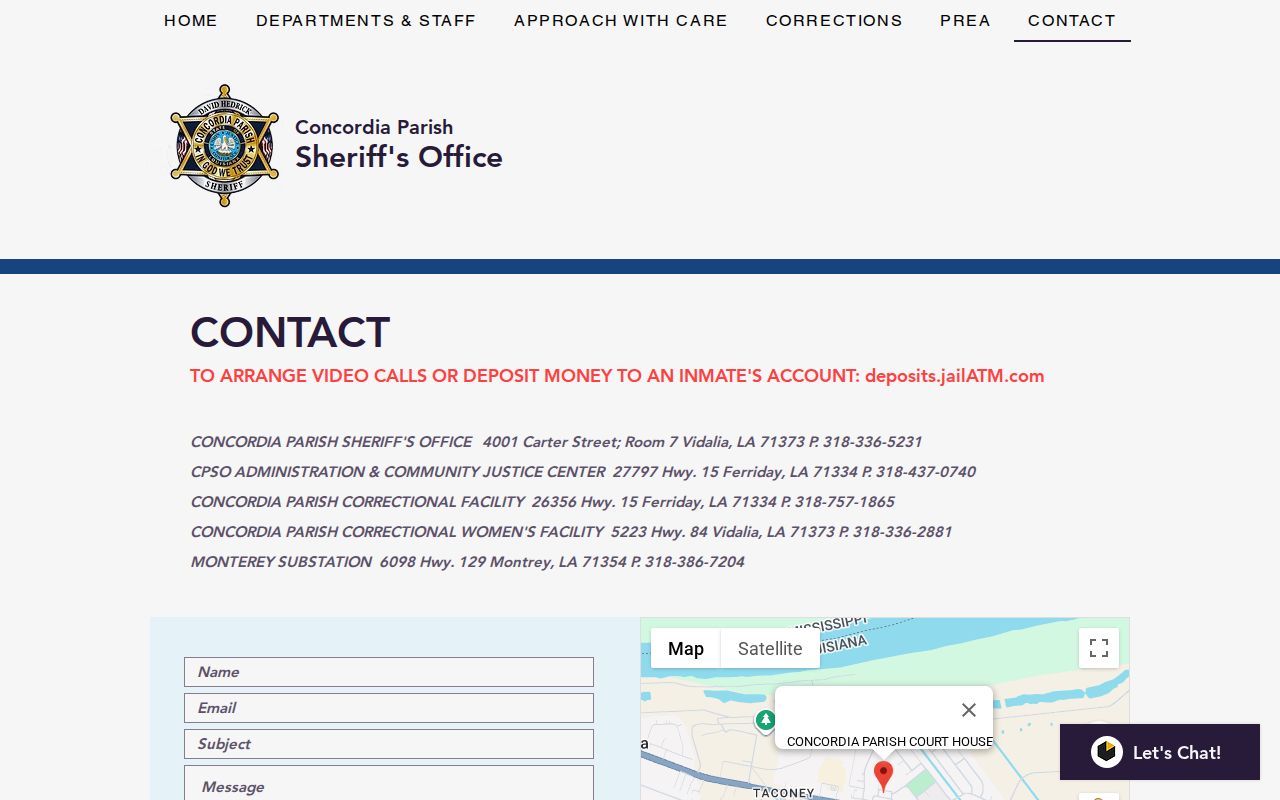
The official contact capture confirms where to begin. It does not settle whether a named person was held at Carter Street or released from that location.
When a caller needs another local facility, ask to be routed to CPCF or CPCF II. If the destination was a state institution, contact DPS&C. Keep the name of the staff unit or source page used, but do not state that an agency confirmed facts unless it actually did.
A useful call log notes the date, number dialed, office reached, and exact facility name staff used. It should omit personal facts that are not needed. That record helps explain why a later written response may name CPCF even when the first public listing pointed to Carter Street.
Carter Street Release Fields
A precise request is more useful than asking whether someone “got out.” It also helps CPSO distinguish the jail listing from the wider corrections complex. Ask for fields in the existing booking and movement record and allow lawful redaction.
| Field | Question answered |
|---|---|
| Booking number and date | Which local custody episode is involved? |
| Booking or holding location | Did Carter Street or another CPSO site handle the person? |
| Actual movement date and time | When did the physical event occur? |
| Release type or authority | Was it bond, court action, time served, completion, or another event? |
| Destination or receiving agency | Did custody end or continue elsewhere? |
| Associated charge and bond entries | What was recorded at booking, apart from the final disposition? |
Under Louisiana Public Records Law, records can still contain protected material. Juvenile, sealed, expunged, victim-confidential, medical, investigative, and security information may be withheld or redacted. Ask CPSO to identify the legal basis it applies. If a booking photo is needed for identity reconciliation, request the image in its existing electronic form with the release sheet and ask for an advance estimate.
Note: The lack of a published local fee or turnaround means a requester should obtain an itemized estimate before costs are incurred.
Carter Street Court Proof
Sheriff Room 7 and Clerk Room 5 sit in the same Carter Street complex but maintain different proof. CPSO records the physical custody event. The Clerk preserves the legal case record. A bond order can authorize release while the jail still processes identification, property, paperwork, and any independent holds. Conversely, a completed exit does not show whether the charge was dismissed or remains pending.
Ask the Clerk for public docket or minute entries and the final disposition or sentencing documents. Useful items can include the bond order, dismissal, plea or verdict, sentence, credit for time served, probation, revocation, commitment, satisfaction, or public expungement-order information. Use a case number where known. Staff can supply records but should not be asked to give legal advice or interpret the outcome.
It may satisfy the custodial part of one count. A separate case, warrant, detainer, consecutive term, or receiving agency can still prevent community exit.
Physical movement and legal disposition should be reported as separate findings. This distinction is particularly useful at Carter Street because administrative, court, booking, and custody roles sit close together.
Carter Street Transfer Branches
If CPSO reports “transferred to DOC,” use Louisiana's LAVNS person search after allowing time for intake. Search by exact name or identification number, compare identity details, and read the location and status fields. The DPS&C telephone locator at 225-383-4580 can report facility assignment, facility contact, assigned probation and parole district, and a projected release date if applicable. A projection is not an actual event.
For completed state custody, request DPS&C incarceration verification. The administrative definition includes the person's name, admission date, release date, dates of incarceration or supervision, and last incarceration location at minimum. That is stronger historical proof than the disappearance of a name from a local list.
A federal transfer splits again. BOP's locator is relevant to sentenced federal incarceration. A pretrial federal defendant may remain with USMS in a local or contracted setting without appearing in BOP, so the federal docket and USMS records route matter. ICE ODLS covers current immigration custody and a limited trail for those reported released from ICE custody. “Not in BOP custody” and “released from ICE custody” are narrow system findings, not proof that every other form of custody or supervision ended.
Carter Street Roster Limits
No official Concordia 24-hour or 72-hour recent-release page was located. No official update cadence, post-release retention period, or released-photo feature was established either. A dated third-party snapshot may show that a name once appeared on a CPSO-branded current roster. If the name is gone later, use the two dates to narrow the request period. Do not label the difference as release.
A roster change can result from community exit, transfer, an internal move, a hold pickup, data correction, duplicate consolidation, escape, or death. Preserve the exact status wording and timestamp. Then ask CPSO for the source entry. If LAVNS later shows community supervision, that can provide affirmative post-custody evidence while still leaving the exact local exit reason to the sheriff record.
- Release
- A recorded exit from a stated custodian. It does not always end the court case or supervision.
- Transfer
- A change of custodian or placement. The person remains in custody.
- Disposition
- The court's recorded legal outcome or action.
- Detainer
- A request or basis for another authority to hold or receive the person.
Note: Always identify the CPSO location that made the entry because the Carter Street listing alone does not prove where long-term custody occurred.