
CPCF Release Destinations
Concordia Parish Correctional Facility is the clearest official adult correctional location operated by the Concordia Parish Sheriff's Office. A person can leave CPCF for the community after bond, dismissal, time served, sentence completion, or another court-authorized outcome. The person may instead move to the women's facility, the Carter Street jail listing, the transitional work program, another parish, Louisiana Department of Public Safety & Corrections custody, federal custody, or immigration custody. Each outcome calls for a different record.
The key question is simple: did custody end, or did custody change hands? A CPSO release entry can show the actual release or transfer date and time, the recorded authority or type, the releasing facility, and a receiving agency when public. A transfer entry is not community release. If the entry names DPS&C, use Louisiana LAVNS and the state locator. If it names ICE, use the ICE locator. If it names another parish, contact that parish's facility rather than continuing to search the CPCF roster.
Identity matching matters at every step. Common names can return several records, and a booking number may apply to only one custody episode. Compare full name, date of birth, arrest date, facility, and any state or federal identifier before accepting a result. Save the source date and exact status wording so a later change can be reconciled with the official release sheet.
Confirm a CPCF Release
Start with exact identity and the last known custody date. Full legal name, date of birth, booking number, and arrest date help CPSO distinguish namesakes. Then ask CPCF whether the person left for the community or went to another facility or agency. Request the actual event date, event type, and destination. The Concordia Parish released-inmate search explains the wider local, state, court, federal, and immigration branches when the next custodian is not clear.
- Call CPCF and provide the person's full name, date of birth, booking number if known, and approximate custody dates.
- Ask whether the recorded event was community release, internal movement, or transfer to another custodian.
- Request the existing release or transfer sheet, including the actual date and time, type, authority, and receiving agency if public.
- Check the Seventh Judicial District case record for the bond order, dismissal, sentence, time-served entry, probation order, or other disposition.
- Follow any receiving agency in its own system. Use LAVNS for DPS&C, BOP or the federal docket for federal cases, and ICE ODLS for immigration custody.
Court and facility records answer different questions. The court file shows the legal action. CPCF records the physical movement. A time-served order, for example, may resolve one count while another hold prevents community exit. Pair the records before describing the result.
CPCF Release Record Contact
Christopher Groh is identified by CPSO as CPCF's warden. The facility contact is the first route for a current or recent movement. CPSO's Carter Street main office is the fallback for a formal local record request. The official pages do not publish release-processing hours, a release exit door, records-office hours, a copy price, a fulfillment period, or a dedicated release-record form. Ask for an electronic copy and an estimate before charges are incurred.
Concordia Parish Correctional Facility26356 Highway 15
Ferriday, LA 71334
Phone: 318-757-1865
Operator: Concordia Parish Sheriff's Office
A focused request should identify the person and date range, then ask for the existing booking summary, actual release or transfer date and time, release type or authority, releasing facility, and receiving agency when recorded and public. It can also request the associated booking photograph in its existing electronic form. Ask CPSO to cite the legal basis for any withheld or redacted field instead of assuming the entire record is unavailable.
The official CPSO contact page supplies the main office route at 4001 Carter Street, Room 7, Vidalia, and 318-336-5231. Its general contact form is a routing option, not a published guarantee of formal-request acceptance or timing.
CPCF Release Record Fields
A useful CPCF record should identify the person and distinguish booking, release, and transfer. Ask for the fields that already exist rather than asking staff to create a narrative. Some information may be redacted under Louisiana law, and not every returned record will contain every item.
| Requested field | What it helps establish |
|---|---|
| Full name, DOB, booking number | Matches the record to the correct person. |
| Booking and admission date | Defines the local custody period. |
| Actual release or transfer date and time | Shows when CPCF recorded physical movement. |
| Release type or authority | Separates bond, time served, court action, sentence completion, and other outcomes. |
| Receiving agency or destination | Shows whether custody continued elsewhere. |
| Charge and bond entries | Provides the booking context, not the final case result. |
Louisiana Public Records Law begins with the broad definition in R.S. 44:1, while R.S. 44:3 protects certain law-enforcement and correctional material. Juvenile, sealed, expunged, victim-confidential, medical, investigative, and security information may be withheld. A custodian should identify the ground used for a denial or redaction. The Seventh Judicial District file remains the better source for the case outcome.
Note: “Released” without a stated reason confirms a reported custody change, not dismissal, acquittal, or the end of all supervision.
CPCF Release Network
Concordia Parish has several nearby correctional labels and programs. The official corrections directory lists CPCF, CPCF II or the women's facility, the Carter Street sheriff's jail, and the transitional work program. Movement among those locations may make a name vanish from one list while custody continues. The transitional program also shares a Highway 84 address with CPCF II, so a placement change should not be reported as a final discharge.
The CPSO corrections page is the source for the local corrections locations shown below.
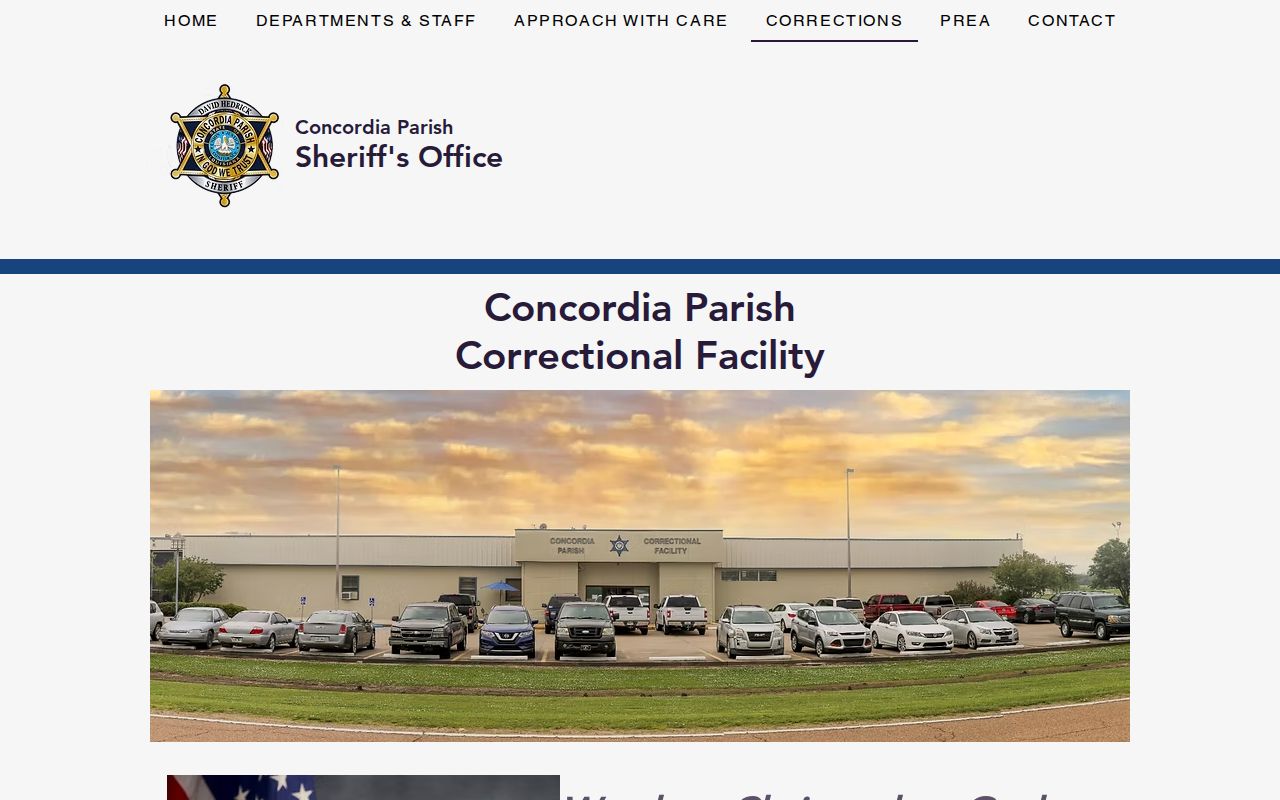
The captured official page helps identify which CPSO location to name in a request, but it does not serve as a live release list or prove a person's current status.
| Next placement | Best confirmation |
|---|---|
| Community after local custody | CPCF release entry plus court disposition |
| Another CPSO location or transitional work | CPSO movement record and the receiving program |
| Louisiana DPS&C | LAVNS, telephone locator, then incarceration verification |
| Federal or immigration custody | Federal docket, BOP or USMS route, or ICE ODLS |
CPCF Roster Exit Limits
No distinct official Concordia 24-hour or 72-hour release feed was found in the reviewed CPSO pages. No official post-release roster retention period was found either. A third-party archive preserves dated current-roster snapshots, but it is not a CPCF release ledger. Comparing an old snapshot with a later view can narrow the period for a records request, yet absence alone cannot tell whether the person bonded out, transferred, was moved internally, or disappeared because of a data correction.
Louisiana LAVNS can provide a second lead. It covers state prisoners and people under probation or parole, and official guidance describes participating parish jail and court records. DPS&C says its locator data is updated every 24 hours, so a newly transferred person may not appear at once. Read the exact status and location. For durable state history, request incarceration verification, which can include admission, release, supervision dates, and the last incarceration location.
If no online result appears, return to the last known custodian. Ask whether identifiers changed during intake, whether another agency accepted the person, and when the movement posted. The absence of a result can reflect data timing as readily as release. A dated CPCF entry remains the firm starting point for each later branch.
Call the agency that supplied the result and request the actual date and coded release type. The status alone does not explain whether the event was bond, sentence completion, transfer, or another outcome.
CPCF Release Property Questions
CPSO's Jail Info page says the sheriff does not accept property for inmates. It does not publish a separate property-return procedure for release, the identification needed at pickup, an exit point, or release-processing hours. A released person or family member should call CPCF before traveling and ask whether stored property is ready, what receipt or identification is required, and whether another CPSO location handles the return.
Bond rules are also local. CPSO states that a property bond cannot be combined with a surety bond, only one bond type may be used, one property may secure one bond, and property outside Concordia Parish is not accepted. Those rules describe a possible route toward physical release. They do not resolve the charge, guarantee immediate exit, or establish that no other hold exists. Confirm the completed exit with CPCF and the legal action with the clerk.
Note: Call CPCF before travel because no official release hour, exit point, or property-return schedule is published for this facility.