
Concordia Parish Release Records
A Concordia Parish inmate who leaves a roster has stopped appearing in that current-custody view. That change does not explain why. The person may have bonded out, received a court-ordered release, completed a parish sentence, moved to Louisiana Department of Public Safety & Corrections custody, entered a transitional work placement, or left with another agency. River Correctional Center adds a separate immigration branch. The record from the agency that made the movement is the best proof of what happened.
Two dates can describe different events. Physical release is the time a facility records an exit or transfer. Legal disposition is the court's action on the charge or sentence. A person can leave on bond while a case remains open, leave prison on parole while a sentence remains active, or finish incarceration and begin probation. For that reason, Concordia Parish release verification often pairs a CPSO release entry with a Seventh Judicial District court record.
- Release
- A recorded exit from one custodian, which may be to the community or another agency.
- Time served
- A court credits custody toward a sentence, subject to other cases, holds, and facility processing.
- Parole
- Release from prison while the sentence continues under community supervision.
- Discharge
- The stated end of an agency's custody or supervision obligation.
Concordia Parish Release Types
The release label controls the next search. Bond and court-ordered release usually send a person from local custody to the community, unless another hold blocks the exit. A transfer changes custodians. It is not a community release. State parole ends prison confinement but starts supervised release, while probation may follow a court order or the custody part of a split sentence. The returned record should be quoted with care.
| Recorded event | What it means | Next proof source |
|---|---|---|
| Bond or recognizance | Release is authorized while the local case continues. | CPSO exit entry and Clerk bond order |
| Dismissal or time served | A court resolved a charge or custodial term, but processing and other holds still matter. | Clerk minutes plus facility release entry |
| Parole or probation | The person is in the community under an active sentence or court order. | LAVNS, DPS&C locator, and assigned district |
| DPS&C transfer | State custody replaced parish custody. | Louisiana person search and telephone locator |
| Federal or ICE pickup | Another sovereign assumed custody. | Federal docket, BOP when applicable, or ICE ODLS |
Escape, death, and a data correction may also remove a name. Neither should be called a release without direct official confirmation. A roster is designed to show current custody, not a final history of every person once held there.
Concordia Parish Bond Releases
Concordia has unusually specific property-bond rules. The CPSO Jail Info page says property and surety bonds cannot be combined, only one bond type may be used, each property can support one bond, and out-of-parish property is not accepted. These limits explain one local path toward release. They do not prove that the jail completed the exit or that the underlying charge ended.
After a bond is approved, obtain both sides of the event. Ask CPSO for the actual release time and any remaining hold or receiving agency. Then ask the Concordia Parish Clerk for the bond order and later docket activity. A bond entry is legal authority for release on that matter; the release entry shows whether physical movement occurred. Another case, warrant, detainer, or agency pickup can keep the person in custody.
Note: Property-bond rules describe how security is posted, while the CPSO release entry records whether and when the person actually left.
Concordia Parish Release Record Fields
A useful local request ties release data back to the booking. CPSO has no published stand-alone release form or online archive, so the requester should name each existing field sought. Ask for the full legal name, booking number, admission and release event, and the facility that made the entry. A coded reason may need a code key. If the movement was a transfer, the destination or receiving agency matters as much as the exit time.
| Field | What it establishes |
|---|---|
| Name and booking number | Connects the event to the correct booking rather than a namesake. |
| Booking or admission date | Marks the start of the custody period being researched. |
| Actual release date and time | Shows when CPSO recorded the exit or transfer. |
| Release type or authority | Identifies bond, court action, sentence completion, transfer, or another coded basis. |
| Releasing facility | Separates CPCF, CPCF II, Carter Street, and program records. |
| Receiving agency or destination | Distinguishes community release from continuing custody elsewhere. |
| Property and hold entries | May document release processing and a barrier to community exit. |
For completed Louisiana felony custody, the more precise state request is an “incarceration verification.” Louisiana Administrative Code Title 22, Part I, Section 101 identifies minimum fields such as the person's name, admission and release dates, incarceration or supervision dates, and last incarceration location. It can also supply publicly releasable disposition or discharge data. This historical proof is stronger than a missing search result.
Request Concordia Parish Release Records
The local starting point is the Concordia Parish Sheriff's Office at 4001 Carter Street, Room 7, Vidalia, Louisiana 71373, 318-336-5231. Its site provides a general contact form, but research found no dedicated records portal, set copy fee, records hours, or fixed response time. Ask the office to identify the proper custodian and submission channel before sending private identifiers.
- Identify the person by full legal name and date of birth or booking number. Add an approximate custody and release range and the likely Concordia Parish facility.
- Request existing booking and release records. Name the actual release or transfer date and time, recorded release type, releasing facility, receiving agency if public, and booking photo if needed.
- Ask for electronic copies and an itemized estimate before costs are incurred. If material is withheld or redacted, request the specific legal basis.
- Compare the returned CPSO event with the court docket. If the record shows a transfer, continue with the receiving state, federal, or immigration system.
Louisiana public-record law addresses inspection, copies, custodian duties, and fees, but the research does not support promising a universal number of days. A narrow request for existing records is easier to process than a demand that the agency create a new narrative. For an older state case, request DPS&C incarceration verification instead of relying on a live locator alone.
Concordia Parish Release Laws
Louisiana R.S. 44:1 broadly defines public records, including documents, photographs, and databases kept in public business. R.S. 44:3 protects specified law-enforcement and security material while preserving public access to identified records such as the initial report and booking records, subject to other law. Code of Criminal Procedure Article 228 requires an open booking book and booking summaries. It does not itself require a release-date field, which is why the request should name the release entry separately.
Expungement changes public visibility. Article 973 generally makes an expunged arrest or conviction confidential, subject to stated exceptions. Misdemeanor and felony eligibility rules in Articles 977 and 978 are detailed and are not automatic erasure. The local release record and court file may therefore have different public limits at different stages. A returned record should be reported only within the scope the custodian makes public.
Find Released Concordia Parish Inmates
Start with the last confirmed custodian. Concordia Parish has several local labels and two outside-custody branches, so repeating a current roster search can miss the answer. Exact identifiers reduce false matches. Use the legal name, date of birth, booking number, DPS&C number, federal register number, or A-number that fits the case.
- Call CPSO or the last local facility. Ask whether the recorded event was community release, internal movement, transfer, or a hold pickup, and request the actual event entry.
- Search Louisiana LAVNS/VINELink for state custody or community supervision. A reported released status is useful, but the originating record explains the reason.
- Call the DPS&C locator at 225-383-4580 for a facility assignment, assigned probation and parole district, and projected release date if applicable.
- Use the Concordia Clerk case record for bond, dismissal, sentence, time served, probation, revocation, or satisfaction. A court order and jail processing can occur on different timelines.
- Follow any receiving agency. Use BOP for sentenced federal custody, the federal docket and USMS route for federal pretrial custody, or ICE ODLS for immigration custody.
- For old events or missing online data, request the CPSO release entry or DPS&C incarceration verification.
The same-day fallback is developed further on the Released Last 24 Hours page. For one named person, however, the branching path above remains the better test because it follows the actual custody type rather than a time window.
Louisiana Release Search for Concordia
Louisiana's public state route is LAVNS through VINELink. The DPS&C Inmate Information page says the locator is updated every 24 hours and can be searched by name, location, and ID or case number. It covers people in prison and people under probation or parole. A community-supervision result can affirm that incarceration ended while a sentence remains active.
The official DPS&C page shows how Louisiana routes person lookups. Review the source before using the search fields.
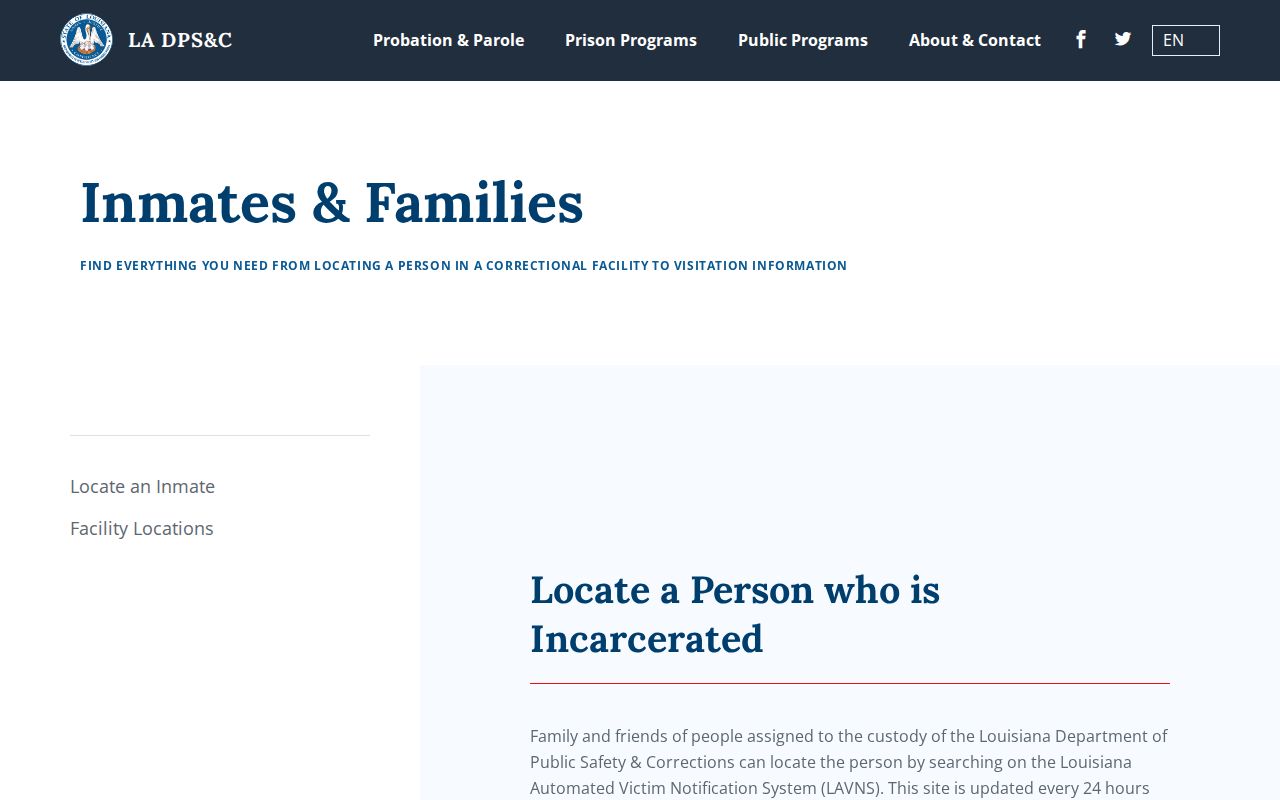
The screen supports the state branch of a Concordia Parish release search, but actual release still requires the originating custody record.
| Search input | Use | Limit |
|---|---|---|
| Exact name | Starts a person search | Namesakes require another identifier |
| Location | Narrows a current source or participating agency | Movement may lag in the feed |
| Offender, defendant, or case number | Improves identity matching | Fields vary by contributing agency |
| Returned status and dates | May show custody, supervision, eligibility, or scheduled release | Scheduled and projected dates are not actual release |
When a state record is complete, it may include an offender number, status, location, sentence-expiration date, parole eligibility, and scheduled release date. Not every source supplies every field. VINELink warns that data can be incomplete or late. Confirm a local event with CPSO and a state event with DPS&C.
Concordia Parish Recent Release Limits
The July 2026 research sweep found no distinct official CPSO 24-hour or 72-hour release feed. It also found no official roster-retention rule, release-hour schedule, or post-release archive. This is a bounded finding. CPSO may change its tools, but a current roster or third-party snapshot must not be relabeled as an official release list.
A dated archive can show that a person appeared in one custody snapshot and not another. That narrows a time range for a request. It cannot establish bond, dismissal, transfer, death, escape, or community release. Ask CPSO for the actual date, time, type, facility, and destination. If the entry shows a transfer, follow the next custodian rather than stopping at the missing roster name.
Note: Current-custody snapshots are discovery leads, while the CPSO release entry and receiving-system record establish the recorded movement.
Concordia Parish Release Property
CPSO states that it does not accept property for inmates. The public pages do not provide a release-property pickup process, exit point, or hours. That silence matters for a person planning transportation or trying to recover belongings after a Concordia Parish release. Call the actual facility before travel and ask what identification, receipt, or authorization is required.
Do not use the Jail Info page's weekday kiosk hours as records hours or release-processing hours. Those published hours concern lobby account funding. CPCF, CPCF II, Carter Street, and the transitional work program may route property questions differently. The correct contact is the facility that held the person immediately before the recorded event.
Concordia Parish Release Proof
Local physical and legal proof sit in the same Carter Street complex but in different rooms. CPSO at Room 7 holds the local booking and release side. The Concordia Clerk at Room 5 maintains the court file. The Louisiana Secretary of State clerk directory is the dependable contact source because the clerk's own site was unreachable during research.
Does a court order prove the person walked out? Not by itself. A bond, time-served, or dismissal entry explains legal action in that case. CPSO must still process the movement and check for other holds. If the court ordered release but custody continues, ask whether a warrant, detainer, consecutive matter, or receiving agency prevents community exit.
The reverse is also true. A CPSO exit entry proves the jail recorded movement, but it does not prove acquittal or dismissal. Pairing both records produces the clearest Concordia Parish release history without forcing one source to answer a question it was not built to resolve.
Concordia Parish Custody Transfers
Concordia's local footprint can make a move look like release. CPCF, CPCF II and the women's facility, the Carter Street jail listing, and the transitional work program are separate labels, buildings, programs, or administrative roles. The state lists the transitional work program at the same Highway 84 address as CPCF II. Assignment there remains correctional custody, not final discharge.
The CPSO Corrections page displays the official local locations and helps identify the source to call.
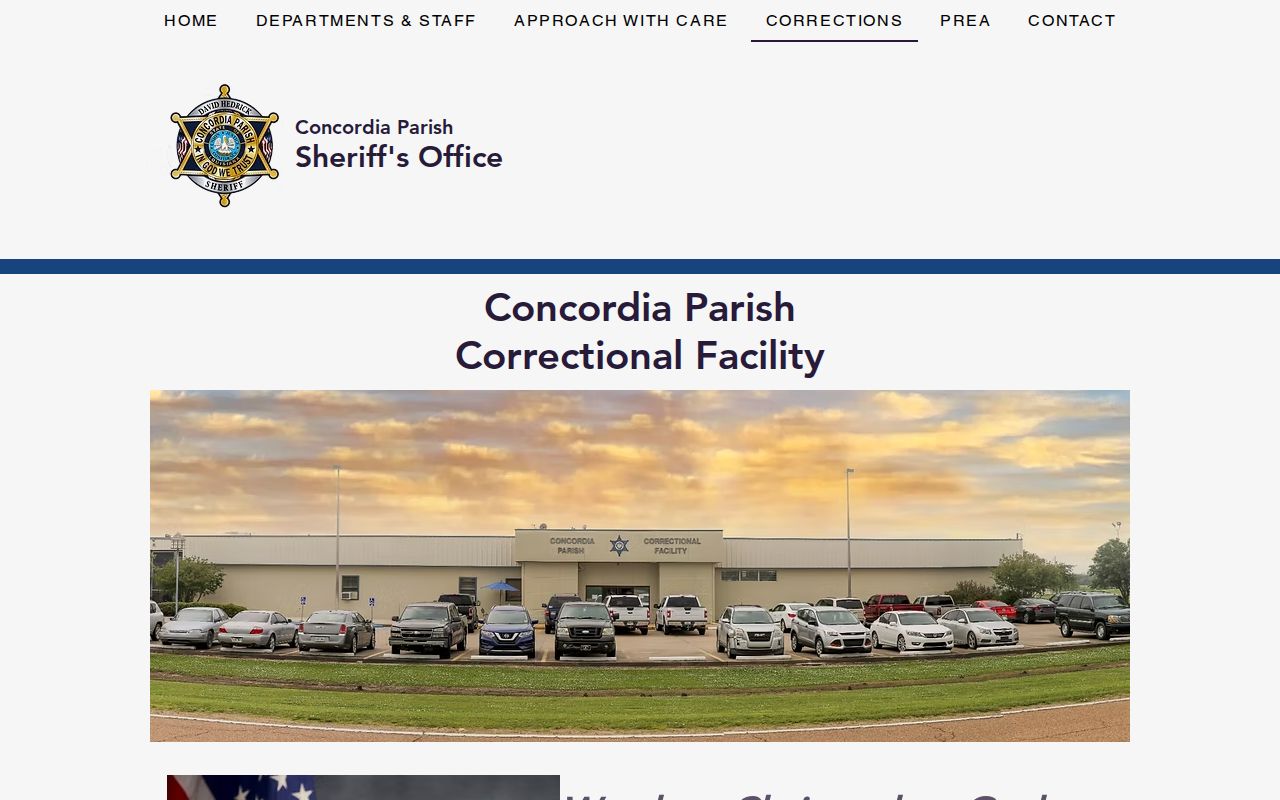
The listed facilities show why a person may vanish from one local view while remaining in the Concordia or Louisiana corrections system.
Ask which facility created the movement entry and whether the person went to the community, another local location, DPS&C, a federal authority, or ICE. When CPSO reports “transferred to DOC,” search the Louisiana person locator after intake processing. The parish transfer date and later state discharge date are two different events.
Concordia Parish Parole After Release
Parole and probation are released-person channels, but neither means full discharge. Parole usually follows prison. Probation is a court-ordered community disposition or may follow the custody portion of a split sentence. Search LAVNS for a community-supervision result, then use the DPS&C telephone locator to identify the assigned district.
Concordia Parish is served by Alexandria District Probation and Parole at 2800 South MacArthur Drive, Suite F, Alexandria, Louisiana 71301, 318-487-5301. Staff may limit person-specific details. Use the office as a routing and verification fallback, not as a promise of disclosure. A favorable parole decision also does not prove physical exit. Confirm the effective event through DPS&C, LAVNS, or incarceration verification. The Parole / Probation page explains that verification path.
River Releases and ICE Records
An official ICE agreement names River Correctional Center, creating a real immigration-custody branch in Concordia Parish. The contract is not a current roster and cannot prove that a named person is at River now. Someone leaving the facility may transfer within ICE, be removed, enter criminal custody, or be released under immigration conditions.
Use the ICE Online Detainee Locator with a nine-digit A-number and country of birth, or exact name, country of birth, and date of birth. Official ICE guidance says ODLS includes current detainees and people released from ICE custody during the prior 60 days. A no-match can result from spelling, identifiers, age limits, timing, or the end of that window. ICE release also does not decide the immigration case or prove community presence in Concordia Parish.
Federal Release Records in Concordia
The verified federal paths differ. The BOP Inmate Locator covers sentenced federal inmates from 1982 forward and can display “Released” or “Not in BOP Custody” with a release date. That narrow status means the person is outside BOP custody, not necessarily outside state, local, ICE, or federal supervision.
USMS controls many federal defendants before conviction and can use local or private beds, but it has no comparable public released-person locator. A person held for USMS may never appear as a sentenced BOP inmate. Use the federal docket for detention, release, dismissal, acquittal, sentencing, or commitment, then seek a properly scoped custody record when needed. These federal routes should not be used for an ordinary Concordia Parish arrest with no federal branch.
| Person's last custody | First search | Best historical proof |
|---|---|---|
| Concordia Parish facility | CPSO call and local record request | CPSO release entry plus court disposition |
| Louisiana state prison | LAVNS and DPS&C telephone locator | DPS&C incarceration verification |
| Federal sentenced custody | BOP locator | BOP record and federal docket |
| Federal pretrial custody | Federal docket and USMS route | Court order and requested custody record |
| Immigration custody | ICE ODLS | ICE and immigration-case records |
Concordia Parish Release Facilities
Each Concordia Parish location needs its own release branch. The local facility pages preserve important distinctions that a single roster cannot show.
- Concordia Parish Correctional Facility is the clearest adult parish correctional location; verify community exit or transfer with CPCF and CPSO.
- Concordia Parish Correctional Facility II / Concordia Parish Correctional Women's Facility has two conflicting official phone listings that should be checked through the CPSO main office.
- Concordia Parish Sheriff's Department Jail is the Carter Street listing; ask whether it created the booking or release entry.
- Concordia Parish Transitional Work Program is a continuing correctional placement, not final release.
- River Correctional Center requires the ICE person-level path rather than assumptions drawn from its contract.
Before acting on any status, record the source, access date, facility, update time, and exact wording. Separate a scheduled date from an actual event, a release from a transfer, and the end of incarceration from the later end of supervision.